
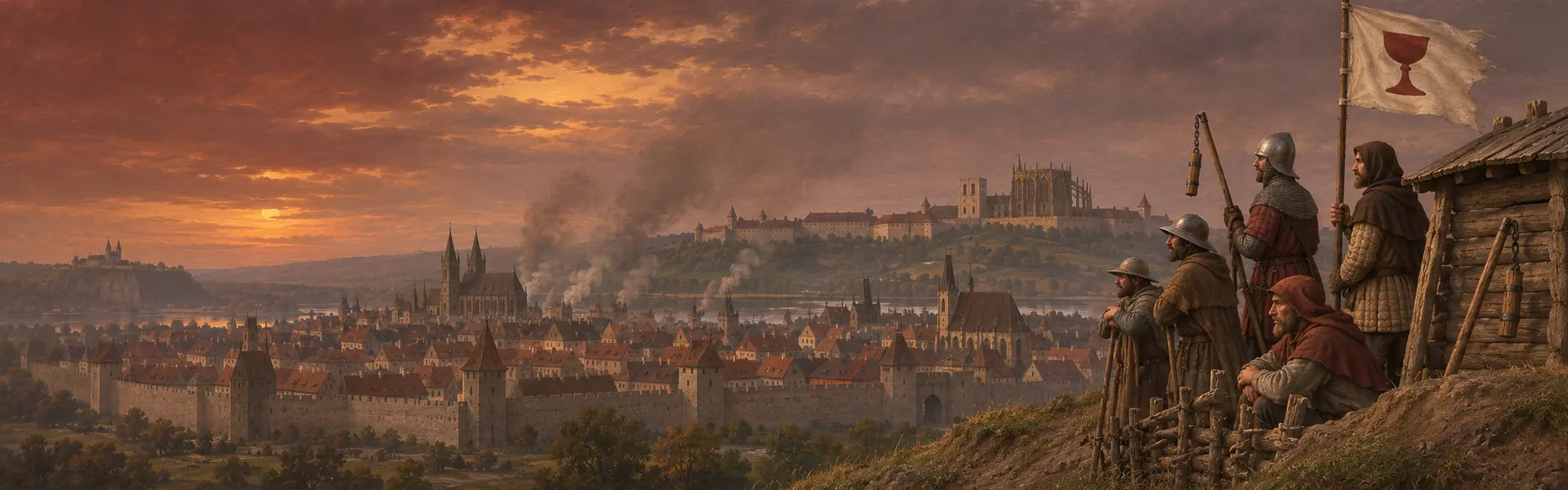
The world of 1420
The game stands on documented history. What seems strange is documented. What is convenient is admitted.
A kingdom divided
Bohemia · 1420
In August 1419 King Wenceslas IV dies. The Hussites refuse to accept his brother Sigismund, King of Hungary and King of the Romans, as King of Bohemia. In March 1420 the Pope proclaims a crusade against them.
The Prague towns stand mostly with the chalice, and in the south Tábor is founded. Plzeň, Kutná Hora, České Budějovice and much of the nobility side with Sigismund and the old Church.
- Town with the chalice
- Town with Sigismund
- Outside Bohemia
- Battle
Border of Bohemia around 1420, simplified. Town allegiance is for 1420; it changed later.
Game calendar 1419–1436
- 1419 Defenestration in Prague
- 1420 Sudoměř and Vítkov
- 1424 Malešov
- 1431 Domažlice
- 1434 Lipany
- 1436 Compacts of Jihlava
The course of the wars
The burning of Jan Hus at Constance in 1415, and of Jerome of Prague a year later, outraged much of the country. The chalice became the sign of Hus’s followers: communion in both kinds, bread and wine, which the Council had banned. King Wenceslas IV tolerated the movement for a long time, and the Utraquists had the support of part of the nobility and most of Prague. Meanwhile radical priests preached in the countryside, and in 1419 crowds of pilgrims came to their gatherings on hilltops.
In the summer of 1419 a crowd led by the preacher Jan Želivský stormed the New Town Hall and threw the councillors from the windows. Soon afterwards Wenceslas IV died. The heir was his brother Sigismund, whom the Hussites blamed for Hus’s death. Catholic lords and some of the towns took his side, and the Hussites began to arm. At Nekmíř and Sudoměř Jan Žižka showed what wagons could do in the field, and in the spring of 1420 Tábor was founded on the Hradiště above the Lužnice.
The Pope proclaimed a crusade against the Hussites, and in the summer of 1420 Sigismund led it to besiege Prague. On 14 July the Hussites under Žižka beat back the attack on Vítkov Hill, and the army, short of money and supplies, broke up. Sigismund still managed to have himself crowned at Prague Castle, but the country did not accept him: in 1421 the diet of Čáslav rejected him and adopted the Four Articles of Prague as a common programme. A second crusade fell apart at Žatec that autumn, and in January 1422 Žižka routed Sigismund’s army at Kutná Hora, Habry and Německý Brod.
The Hussites soon split into leagues. Beside those of Prague and Tábor, an East Bohemian league formed around Žižka, whose men called themselves the Orphans after their captain’s death, and later a smaller league of Žatec and Louny. Their field armies became standing, almost professional forces. The leagues fought each other as fiercely as they fought the Catholics: at Malešov in 1424 Žižka defeated Prague and its allies. Only a common enemy could unite them, as in 1426 at Ústí nad Labem, where together they defeated a Saxon army.
The later crusades fared worse than the first. In 1427 the crusading army fell apart at Stříbro and Tachov, and in 1431 it fled from Domažlice almost without a fight. Meanwhile the field armies under Prokop the Bald marched into Silesia, Lusatia, Saxony, Bavaria, Austria and Hungary. On the so-called glorious rides they sought loot, food and fodder, because the plundered country could no longer feed them. In 1433 the Orphans went as far as the Baltic to help Poland against the Teutonic Order.
The failure of the crusades pushed the Church to negotiate. In 1433 Hussite envoys defended the Articles at the Council of Basel, and the talks went on after they returned. The field armies meanwhile besieged Plzeň in vain for almost a year, and the countryside that had to feed them turned away from them. The moderate Hussites allied with the Catholic nobility and on 30 May 1434 defeated the field armies at Lipany; Prokop the Bald fell in the battle. In 1436 the Compacts were proclaimed in Jihlava and Sigismund was accepted as king. The last resistance ended in September 1437 with the fall of Sion castle, held by Jan Roháč of Dubá.
From Constance to Jihlava
The wagon fort
Before a battle or in camp, farm wagons were joined into a ring or a line, wheel to wheel, with chains and beams closing the gaps. Between the wagons stood people with infantry weapons; inside were the guns and the supplies.
Firearms of the time were simple. A hand cannon is a barrel on a wooden shaft, fired by touching a match to the touch hole, with no lock and no stock. The heavier hook gun has a hook under the barrel that takes the recoil. Beside them, crossbows, flails and spears.
What the war left behind
The country came out of the wars devastated. Foreign trade nearly stopped, the Kutná Hora mines lost skilled miners when the Germans were driven out, and the coinage lost value. Feeding thousands of standing soldiers was beyond the countryside, especially after years of bad harvests.
War, hunger and returning plague emptied the land, and hundreds of villages disappeared during the 15th century. Estimates put the population of the Bohemian lands at around three million in 1400 and under two million in 1526.
Both sides committed atrocities, most often after taking towns that had refused to surrender. Hussites killed the Catholic men of Prachatice and the people of Chomutov, Catholics threw captured Hussites down the mine shafts of Kutná Hora, and after Lipany the victors burned hundreds of prisoners in barns.
Many monasteries and churches were plundered, and iconoclasts destroyed a great number of paintings, statues and books. Building stopped, even on St Vitus Cathedral, and masons found work mainly on fortifications. The University of Prague declined, several faculties closed and many town and village schools disappeared.
Yet something remained that existed nowhere else in Europe at the time: the Compacts allowed Catholics and Utraquists to live side by side in one country. The peace did not hold. In 1462 the Pope refused to confirm the Compacts, a new crusade came under King George of Poděbrady, and only the religious peace of Kutná Hora settled matters in 1485.
The Hussite way of fighting outlived the wars. Czech mercenaries with wagons were in demand throughout the 15th century, and Jan Jiskra of Brandýs fought with them for years in Hungary. As late as 1504, Czech mercenaries fought behind a wagon fort near Regensburg against the army of Maximilian I of Habsburg.
What is not true
Žižka invented the wagon fort.
Wagon camps are older. The Hussites took them to an exceptional use in the field, but did not invent them.
Czechs against Germans.
That is a 19th-century view. It was about faith, property and power. Czech Catholic lords fought against the Hussites, and there were Germans among the Hussites.
The Hussites were one army.
They were divided and fought each other too, most bitterly at Malešov and at Lipany.
The crusaders came in hundreds of thousands.
Figures like 130,000 men at Domažlice are a chronicler’s exaggeration.
The Hussites invented the pistol.
The hand cannon is an early firearm. Pistols developed only with the wheel lock in the early 16th century.
We know what Žižka looked like.
The surviving portraits are late. His real face is unknown.
A hymn was enough at Domažlice.
That singing drove the crusaders off is tradition. What decided it was the crusaders’ divided command and the fast advance of the united Hussites. The army fled before any fighting began.
Lipany ended the war.
It ended the power of the field armies. Peace came only with the Compacts in 1436, the last resistance fell at Sion in 1437, and Bohemia went to war over faith again under George of Poděbrady.
How we treat history
We do not mock anyone’s faith and we do not reduce the chalice to a logo. The violence of the time is shown plainly, without glorifying it.
We check dates and events against scholarly literature, editions of sources and museum records. Where we are not sure, we say so.